The rising scrutiny on the high levels of heat generated from mission-critical facilities has pushed operators to explore new approaches to mitigate the problem by integrating sustainable cooling strategies. One such strategy operators are leaning on is liquid cooling, which, in recent years, has resulted in data center builders and operators rethinking the design of data centers. Liquid cooling seems to be the answer, though it comes in various forms.
Driven by high-density computing from AI workloads, 17 percent of data centers already use liquid cooling. This number is expected to increase to nearly 50 percent in the next five years. The complication, however, is that liquid cooling technologies come in many forms, and are a deviation from datacenter infrastructure norms, leading to expensive bets on new infrastructure to support the various forms of this emerging cooling technology.
How Does Liquid Cooling Function?
Simply, liquid cooling removes heat from all the IT equipment, including networking devices, storage, and servers, by using water (typically mixed with glycol and additives) or other dielectric fluids. Liquid cooling supports high-density racks and servers, by quickly absorbing and driving heat from devices more effectively than air coolants. By eliminating the use and reliance on HVAC systems, Power Usage Effectiveness (PUE) is lowered, which helps elevate the overall energy efficiency across data centers. A favorable side effect of this is that liquid cooling systems are less noisy than multiple fans operating simultaneously.
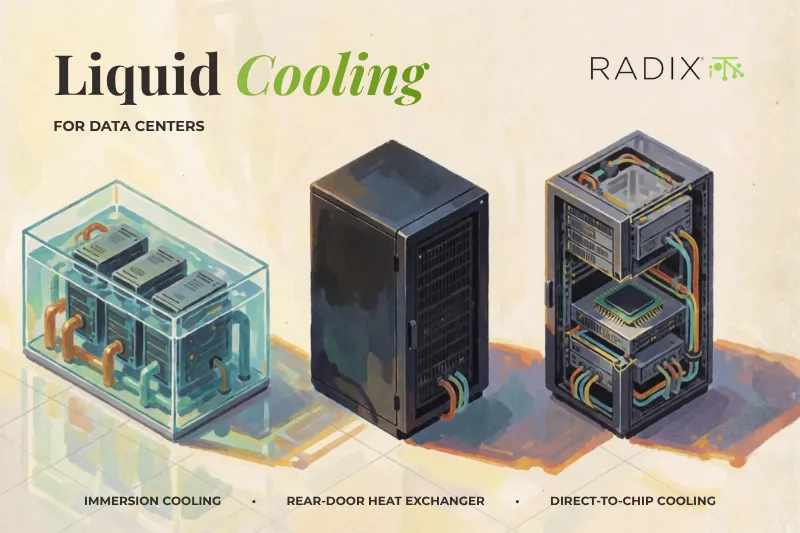
There are various types and designs of liquid cooling, with some of the most commonly used types including:
Direct-to-Chip Cooling delivers liquid coolant directly to metal cold plates mounted on chips such as CPUs and GPUs, absorbing and transporting heat away from high-power components. There are single-phase (liquid remains liquid) and two-phase (liquid boils and condenses) versions, with two-phase systems offering even greater efficiency, especially for AI and high-performance computing workloads.
Immersion Cooling submerges whole servers, or individual components, in a dielectric (non-conductive) liquid, eliminating the need for airflow, and enabling very high-density deployments. This is invasive work, and risky to deploy and typically reserved for environments where conventional airflow is not sufficient, such as advanced research labs and crypto mining operations.
Rear-Door Heat Exchanger, or RDHx systems, mount radiator-like exchangers to the rear of server racks, removing heat from exhaust air as it leaves the servers, using liquid-cooled coils. These hybrids are often used to upgrade existing air-cooled racks without changing server internals.
Keeping Tabs on Liquid Cooling Impact
Unlike traditional forced air-cooling, which is typically controlled and monitored via building management systems (BMS), liquid cooling monitoring and management are often very dependent on the manufacturer, and given the rapid evolution of the technology are at this stage often proprietary; hence, alternatives are often needed to bridge the divide of technologies.
IoT platforms enable a level of visibility into the volume and pressure of their liquid coolant flow meters, while also allowing for leak detection sensors and views of the fluid quality across a consolidated dashboard, allowing for rapid notification and triage when parameters move outside thresholds.
Additionally, mission-critical facility operators integrating liquid cooling strategies are often required to provide their stakeholders (either internal or external clients via SLAs) with impact-proof of operational integrity and resulting energy metrics. To accomplish this, operators can use the same IoT platform that offers real-time facility-wide data visibility from all their connected devices and sensors, regardless of the technology choice in liquid cooling, providing end-to-end visibility for operators.
IoT platforms allow operators to optimize cooling by easily adjusting coolant flow rates based on real-time views of server workloads. This integration and fine-tuning of server-level telemetry—such as CPU/GPU temperatures and workload—facilitates efficient cooling delivery, optimizing energy usage while maintaining thermal safety.
Given IoT platforms also store all telemetry, operators can also use IoT platforms to foster preventative and predictive analytics, to monitor and analyze such factors as pump vibration patterns, and pressure and flow rates to determine issues before they become critical risks. For example, a sudden current increase in a pump motor is flagged so operators can preempt equipment failures by expediting maintenance.
IoT platforms are much more than just ecosystems that can deal with this emerging cooling technology. As data center operations continue to be under heavy scrutiny of energy use spikes, stakeholders require operators to provide regular integrated reporting on energy efficiency, sustainability, and overall effective cost implications. Operators can use IoT platforms to collect and calculate PUEs—both real-time and historical data—to accurately measure the cooling system’s energy consumption while also allowing for detailed reporting on a wide range of metrics needed to achieve operational requirements.
Future Proofing Data Center Power Capacity
As liquid cooling becomes the critical path forward for AI-driven, high-density data centers, the conversation must shift from adoption to intelligent integration. Cooling is no longer a static utility. It’s active and requires the ability to dynamically change through continuous optimization and oversight.
IoT platforms serve as the connective fabric between physical cooling infrastructure and digital intelligence, enabling operators not just to see what’s happening within their liquid and forced-air systems, but to act on it in tandem with the many other factors that make a data center work.
As technology matures, liquid cooling will demand more agile, integrated control frameworks that can evolve with new equipment designs, changing workloads, and regulatory pressures. Operators equipped with IoT-driven insights will not only manage today’s thermal challenges but also prepare for tomorrow’s operational complexities.
The future of data center sustainability rests on this convergence of both existing infrastructure and innovation: advanced liquid cooling systems intelligently monitored and fine-tuned through IoT platforms; working together with existing technology and requirements to ensure every watt and every drop of coolant delivers maximum efficiency, reliability, and operational resilience.